Best Rugged External SSD in 2026
TL;DR — Quick Answer
The SanDisk Extreme Portable V2 is the best rugged SSD for most people — proven, IP55-rated, and widely available. For true waterproofing, the CalDigit Tuff Nano+ (IP67) or Samsung T7 Shield (IP65) step things up without breaking the budget. The LaCie Rugged SSD Pro5 is the only rugged drive that also delivers Thunderbolt 5 speeds for professional video. Skip ruggedised drives entirely if you keep your SSD in a padded case at a desk — you’re paying a premium for protection you don’t need.
Quick Comparison
| Product | Interface | Speed | Best For | Buy |
|---|---|---|---|---|
| SanDisk Extreme Portable V2 IP55, 2m drop |
USB 3.2 Gen 2 (10Gbps) | 1,050 MB/s | Best all-rounder | Amazon |
| Samsung T7 Shield IP65, 3m drop |
USB 3.2 Gen 2 (10Gbps) | 1,050 MB/s | Balanced rugged + speed | Amazon |
| LaCie Rugged SSD Pro5 IP68, 3m drop |
Thunderbolt 5 | 6,700 MB/s | Pro video, maximum rugged | Amazon |
| CalDigit Tuff Nano+ IP67 |
USB 3.2 Gen 2 (10Gbps) | 1,055 MB/s | Compact + waterproof | Amazon |
| Sabrent Rocket Nano Rugged IP67, 1m drop |
USB 3.2 Gen 2 (10Gbps) | ~1,000 MB/s | Aluminum + waterproof | Amazon |
| Kingston XS2000 IP55 w/sleeve |
USB 3.2 Gen 2×2 (20Gbps) | 2,000 MB/s | Speed + ruggedness | Amazon |
How We Picked
- IP rating authenticity: We only list drives with independently certified IP ratings. “Water-resistant” marketing language with no IEC 60529 rating number is not a rugged drive.
- Drop resistance methodology: Drop ratings from manufacturers vary — some test on carpeted surfaces, others on concrete. We note where methodology isn’t disclosed.
- Real-world speed: Rugged drives trade thermal efficiency for durability. We look at sustained, not burst, speeds.
- Size and carry-ability: A rugged drive you leave at home defeats the purpose. We favour drives under 100g.
- Interface compatibility: USB-C with USB-A adapter covers the widest range of devices in the field.
- Pricing context: NAND flash prices rose sharply in early 2026 due to AI-related demand. Check current prices before buying — these drives are affected by that market shift.
Understanding IP Ratings: What Do They Actually Mean?
IP stands for Ingress Protection. The two digits after “IP” represent distinct ratings:
- The first digit (1–6) rates dust resistance. 6 means fully dust-tight.
- The second digit (1–8) rates liquid resistance. Higher is better.
| Rating | Liquid protection | What it means in practice |
|---|---|---|
| IP55 | Water jets from any direction | Handles rain, splashing, a dropped water bottle nearby |
| IP65 | Water jets from any direction (stronger test) | Same as IP55 but tested at higher pressure |
| IP67 | Immersion up to 1 metre for 30 minutes | Can survive a brief dunking in a puddle, pool, or river |
| IP68 | Immersion beyond 1 metre (manufacturer-specified depth) | LaCie Pro5 specifies 3m for 30 min — meaningful protection |
For most outdoor use, IP65 or IP67 is sufficient. IP55 handles rain and mud confidently. IP68 is for genuine submersion risk — kayaking, diving, construction sites near water.
Note: IP ratings are tested with fresh water. Salt water, sand in suspension, and chemical liquids can damage drives rated for plain water.
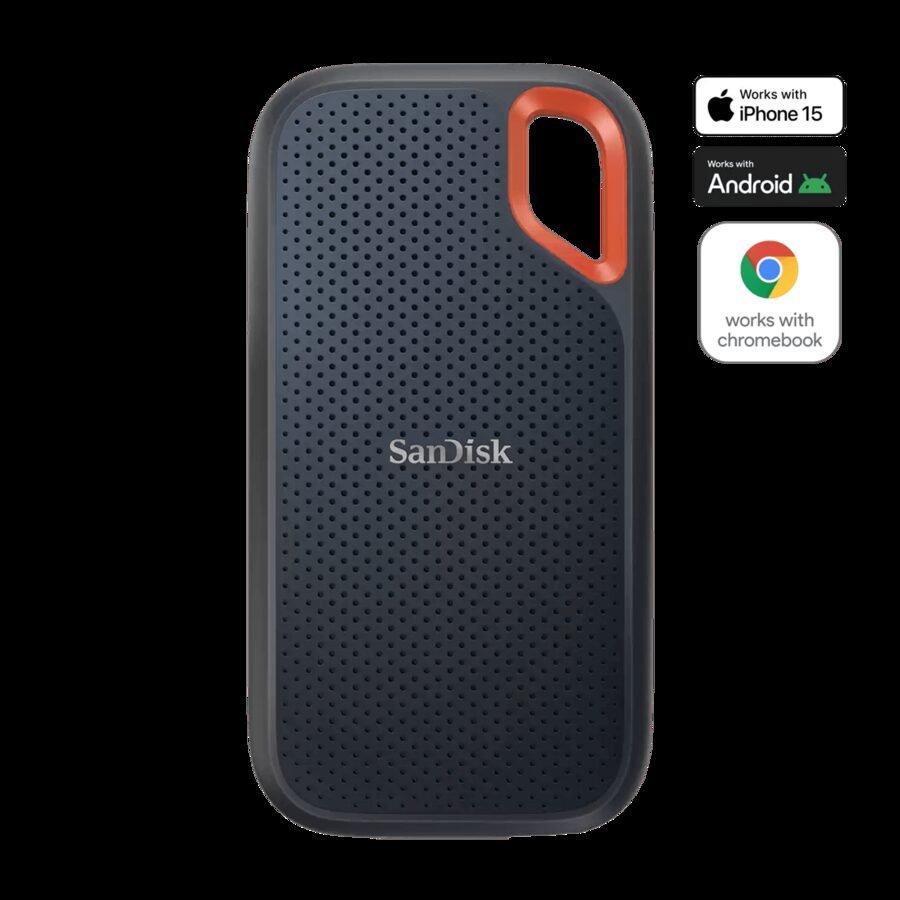
SanDisk Extreme Portable V2 — Best Rugged SSD for Most People
- Capacity options: 1TB, 2TB, 4TB
- Interface: USB 3.2 Gen 2 (10Gbps), USB-C
- Sequential read: up to 1,050 MB/s
- Sequential write: up to 1,000 MB/s
- IP rating: IP55 (dust-resistant, water-jet resistant)
- Drop resistance: Up to 2 metres
- Warranty: 5 years
The SanDisk Extreme Portable V2 is the benchmark for rugged portable SSDs at this price tier. It has an established reputation among outdoor photographers, travel journalists, and drone operators who need a drive that handles the knocks of real fieldwork. The IP55 rating means it can sit through a rain shower, get splashed at a waterfall, or survive a muddy camera bag without issue. The carabiner loop lets you clip it directly to a harness, bag, or tripod strap.
At 10Gbps, it delivers 1,050 MB/s sequential reads in ideal conditions. Real-world transfers — large RAW files, 4K video clips, mixed workloads — land around 800–900 MB/s sustained, which is fast enough for any field editing workflow. The V2 firmware update resolved the data-loss issue that affected early Extreme Portable units, so current-production models are reliable. The 5-year warranty is industry-leading at this price point.
This drive suits travel photographers, adventure videographers, field researchers, and anyone who regularly uses storage in environments where drops and rain are realistic risks.
Samsung T7 Shield — Best Rugged SSD for Speed + Durability Balance
- Capacity options: 1TB, 2TB, 4TB
- Interface: USB 3.2 Gen 2 (10Gbps), USB-C
- Sequential read: up to 1,050 MB/s
- Sequential write: up to 1,000 MB/s
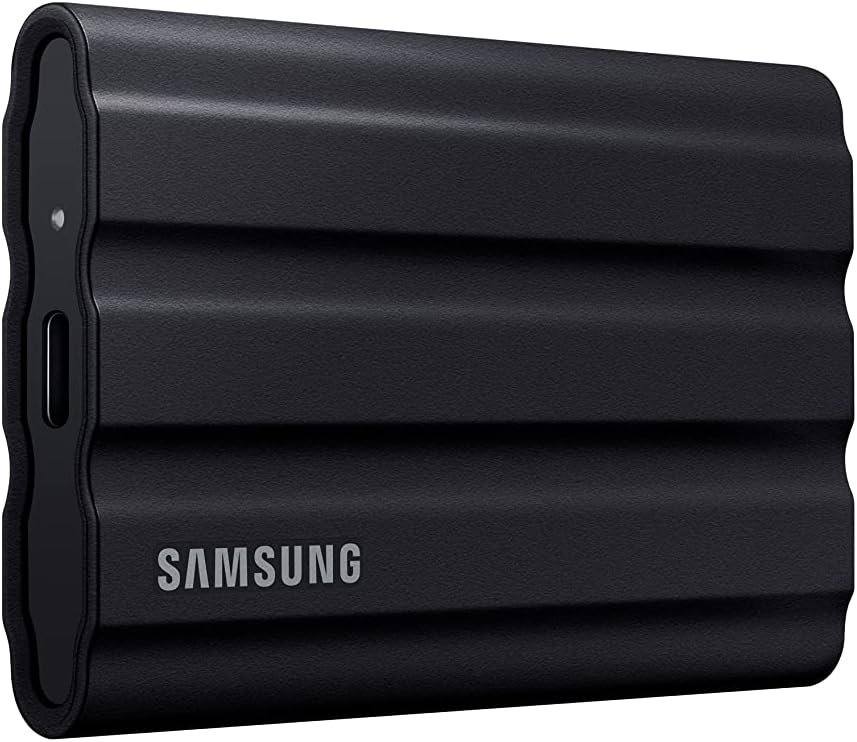
- IP rating: IP65 (dust-tight, strong water-jet resistant)
- Drop resistance: Up to 3 metres (9.8 feet)
- Warranty: 3 years
The Samsung T7 Shield improves on the SanDisk Extreme V2 in two important ways: its IP65 rating is a step up from IP55 (tested at higher water pressure), and its 3-metre drop resistance is a full metre better. Samsung wraps the drive in a textured elastomer shell with a tactile, grippy surface — this feels more drop-proof in hand, not just on paper. At 98g, it’s slightly heavier than the V2 but still pocketable.
Real-world performance tracks closely with the Extreme V2 at the same 10Gbps interface ceiling. Benchmarks from Tom’s Hardware and Shuttermuse show the T7 Shield sustaining around 900–950 MB/s for large sequential writes, which is consistent and reliable. The Samsung Portable SSD app adds AES 256-bit encryption for sensitive data.
The T7 Shield is the better choice if you want slightly stronger protection specs than the SanDisk V2 and trust Samsung’s ecosystem. It’s widely available and frequently discounted.
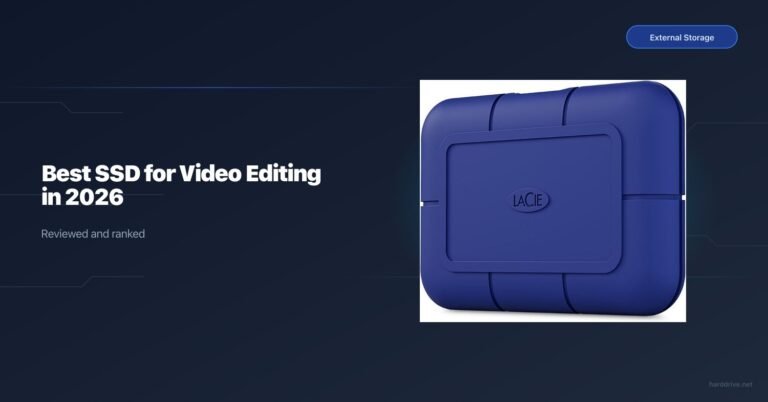
LaCie Rugged SSD Pro5 — Best Rugged SSD for Professional Video
- Capacity options: 2TB, 4TB
- Interface: Thunderbolt 5 (up to 120Gbps)
- Sequential read: up to 6,700 MB/s
- Sequential write: up to 5,300 MB/s
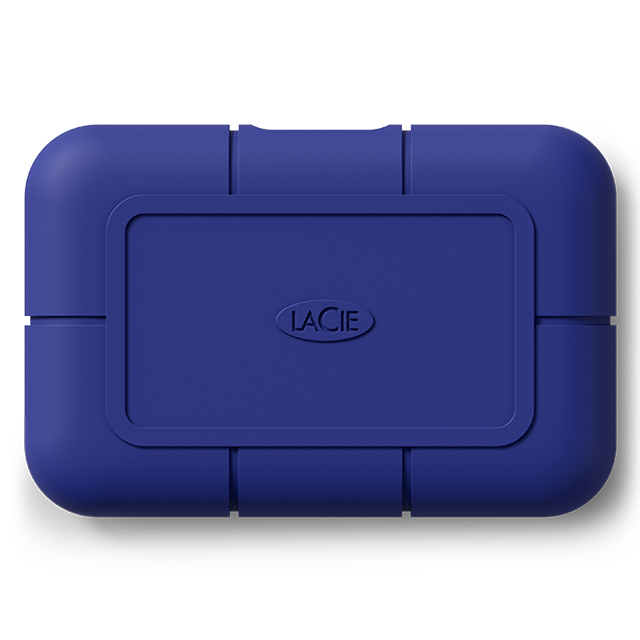
- IP rating: IP68 (dust-tight, 3-metre immersion for 30 min)
- Drop resistance: Up to 3 metres; survives 2-ton vehicle pressure
- Warranty: 5 years
The LaCie Rugged SSD Pro5 is a statement product: the only external drive that combines Thunderbolt 5 speeds with top-tier IP68 protection. The iconic orange bumper shell has been on LaCie drives for years, and the Pro5 version is the most capable iteration. IP68 here means 3 metres of submersion for 30 minutes, tested and specified by the manufacturer. The drive has also been rated to survive a 2-tonne vehicle rolling over it — a spec that matters on working film sets.
The Thunderbolt 5 connection delivers 6,700 MB/s sequential reads on M4 Pro and M4 Max Macs — fast enough to scrub 8K BRAW footage, play back multi-stream ProRes RAW, or run a full DaVinci Resolve session without offloading. On TB4 machines you’ll see around 2,700–3,200 MB/s, still excellent. The drive includes a Thunderbolt 5 cable in the box, which is thoughtful given cable costs.
This is the definitive choice for film and TV production, high-end photography, and anyone who needs the fastest possible portable storage that can also survive a rainstorm, a river crossing, or an accidental run-over.
CalDigit Tuff Nano+ — Best Compact Waterproof SSD
- Capacity options: 512GB, 1TB, 2TB
- Interface: USB 3.2 Gen 2 (10Gbps), USB-C (Thunderbolt 4 compatible)
- Sequential read: up to 1,055 MB/s
- Sequential write: up to ~1,000 MB/s
- IP rating: IP67 (dust-tight, 1-metre immersion for 30 min)
- Drop resistance: Rigid aluminium chassis (no specific drop rating stated)
- Warranty: 3 years
The CalDigit Tuff Nano+ is the smallest IP67 external SSD on the market. It’s smaller than a pack of cards, weighs 100g, and the waterproof USB-C connector is sealed — not just protected by a rubber flap you’ll inevitably leave open. IP67 means you can drop this in a puddle, rinse it under a tap, or leave it in a kayak deck bag without worry.
It’s also Thunderbolt 4 compatible, which matters to Mac users. While the 10Gbps USB 3.2 Gen 2 interface caps speeds at around 1,055 MB/s, the Thunderbolt 4 compatibility means it slots neatly into MacBook Pro and Mac Studio workflows without dongles. CalDigit is known for build quality, and the Tuff Nano+ aluminium shell validates that reputation.
This is the best rugged drive for Mac users, urban professionals who travel frequently, and field workers who need genuine waterproofing in a truly pocketable size.
Sabrent Rocket Nano Rugged — Best Aluminium Waterproof SSD
- Capacity options: 512GB, 1TB, 2TB
- Interface: USB 3.2 Gen 2 (10Gbps), USB-C
- Sequential read: up to 1,000 MB/s
- Sequential write: up to 1,000 MB/s
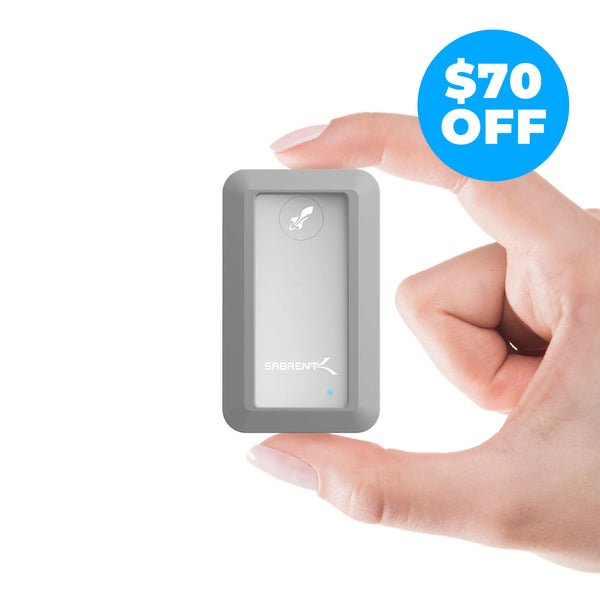
- IP rating: IP67 (1-metre immersion for 30 min)
- Drop resistance: Up to 1 metre (3.3 ft)
- Warranty: 1 year
The Sabrent Rocket Nano Rugged is CNC-machined from aerospace-grade aluminium and rated IP67. The all-metal construction acts as a heatsink, which helps sustain performance during long transfers. It’s genuinely pocketable and feels robust in hand — more premium than its price suggests. At 10Gbps, speeds land around 900–1,000 MB/s sequential.
This drive gets overlooked because Sabrent doesn’t have the brand recognition of Samsung or SanDisk, but the hardware is solid. The aluminium body doubles as thermal management, and IP67 means actual submersion protection. It works across PC, Mac, and is bus-powered.
The main caveat is the 1-year warranty, which is the shortest of any drive on this list. That’s a meaningful risk signal for a device you’re taking into harsh conditions.
Kingston XS2000 — Fastest Rugged-ish SSD
- Capacity options: 500GB, 1TB, 2TB, 4TB
- Interface: USB 3.2 Gen 2×2 (20Gbps), USB-C
- Sequential read: up to 2,000 MB/s
- Sequential write: up to 2,000 MB/s
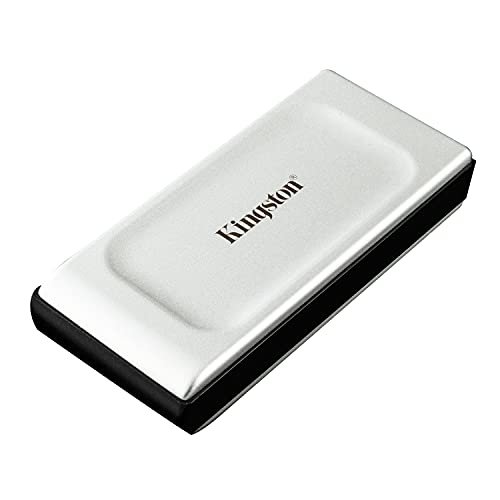
- IP rating: IP55 (with included ruggedized sleeve; not rated without sleeve)
- Drop resistance: Up to 1.8 metres (6 ft) with sleeve
- Warranty: 5 years
The Kingston XS2000 is technically not a rugged drive — it’s a very fast 20Gbps SSD that ships with a removable rubber sleeve that adds IP55 protection. That’s an important distinction: remove the sleeve and there’s no rugged rating. Keep the sleeve on and you get protection with a 1,050 MB/s ceiling (the sleeve may throttle airflow at sustained 20Gbps loads).
What makes the XS2000 interesting in a rugged context is its USB 3.2 Gen 2×2 interface. On a machine that supports 20Gbps, you’ll see up to 2,000 MB/s — double the SanDisk, Samsung T7 Shield, or CalDigit. If you regularly transfer multi-hundred-gigabyte files in the field and your laptop has a 20Gbps port, this drive saves real time. The 5-year warranty is competitive.
This is the right pick if speed is your primary need and ruggedness is secondary — the sleeve handles rain and dust, which covers most outdoor scenarios that don’t involve submersion.
Frequently Asked Questions
What IP rating do I actually need?
For rain and outdoor use, IP55 is sufficient. For hiking, beach photography, or any environment where you might briefly submerge the drive, get IP67 minimum. IP68 (LaCie Pro5) is for professional scenarios where the drive could be underwater for extended periods — film productions, scientific fieldwork, construction near water.
What does IP55 vs IP67 mean for a drive?
IP55 means the drive is protected against dust ingress (not fully dust-tight) and sustained water jets from any direction. IP67 means the drive is fully dust-tight and can be submerged in up to 1 metre of water for 30 minutes. IP68 (as on the LaCie Pro5) extends submersion depth beyond 1 metre — the manufacturer specifies 3m for 30 minutes. Neither IP65 nor IP55 protect against full immersion; only IP67 and above do.
Can I use a rugged SSD in saltwater environments?
IP ratings are tested with fresh water. Saltwater, sand in suspension, and corrosive chemicals are not covered. For marine environments, rinse the drive with fresh water after salt exposure and dry thoroughly before connecting.
Do rugged SSDs get hot?
More than non-rugged drives, because the protective shells add thermal mass and reduce airflow. Aluminium shells like the Sabrent Rocket Nano Rugged and CalDigit Tuff Nano+ dissipate heat better than rubber-encased drives. If you’re doing sustained large transfers in warm environments, expect some throttling on rubber-shelled drives after 15–20 minutes of continuous writes.
Are rugged SSDs worth the extra cost?
For office or home desk use, no — buy a standard external SSD for less. For travel, outdoor work, or any situation where the drive is in a bag, on a vehicle, or exposed to elements regularly, yes. The premium over non-rugged drives is a modest premium. Replacing a failed drive and losing data costs far more.
What’s the best rugged SSD for drone footage?
The SanDisk Extreme Portable V2 is the most popular choice among drone pilots — lightweight, IP55, carabiner loop for clipping to a gimbal bag, and fast enough for 4K footage. For 6K or 8K RAW from high-end cinema drones, consider the LaCie Rugged SSD Pro5.
Is the Samsung T7 Shield better than the SanDisk Extreme V2?
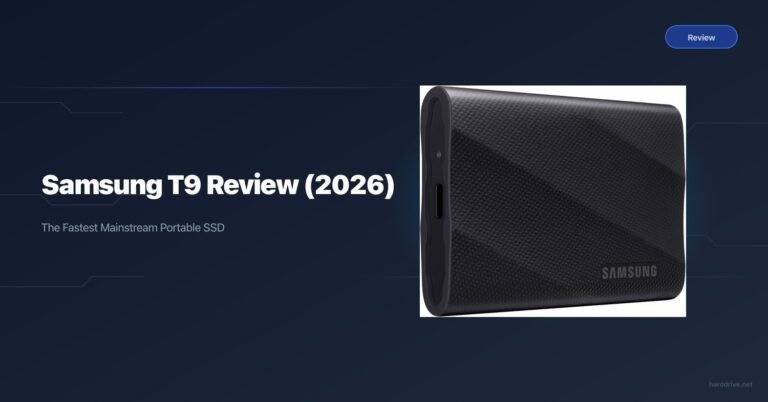
They’re close. The T7 Shield has a slightly better IP65 rating (vs IP55), a longer 3-metre drop spec (vs 2 metres), and a grippier rubberised shell. The SanDisk V2 has a longer 5-year warranty (vs Samsung’s 3-year) and a carabiner loop the T7 Shield lacks. Both perform nearly identically at the same 10Gbps interface. See our Samsung T9 review for context on how the T9 improves on both.
Can I use a rugged external SSD for gaming?
Yes. The Samsung T7 Shield and SanDisk Extreme V2 are both listed as compatible with PS5 and Xbox Series X|S. For console use, the ruggedness is a bonus — more relevant is whether the drive is fast enough (any 10Gbps+ drive is) and whether it has a USB-C cable included.
Related Reads
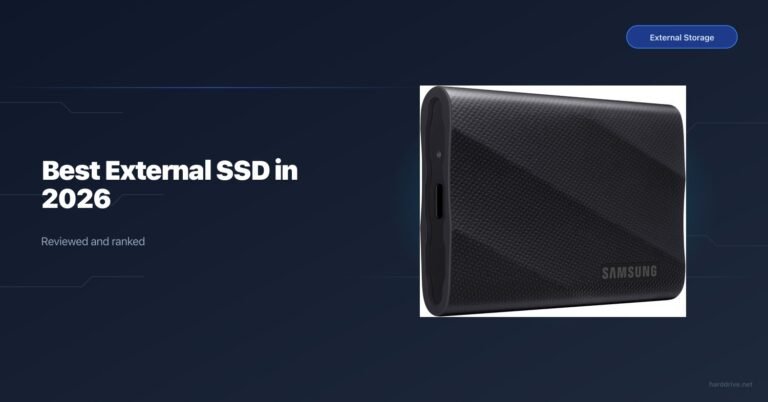
- Best External SSD in 2026 — all external SSDs, not just rugged
- Samsung T9 Review — the fastest non-rugged option reviewed in full
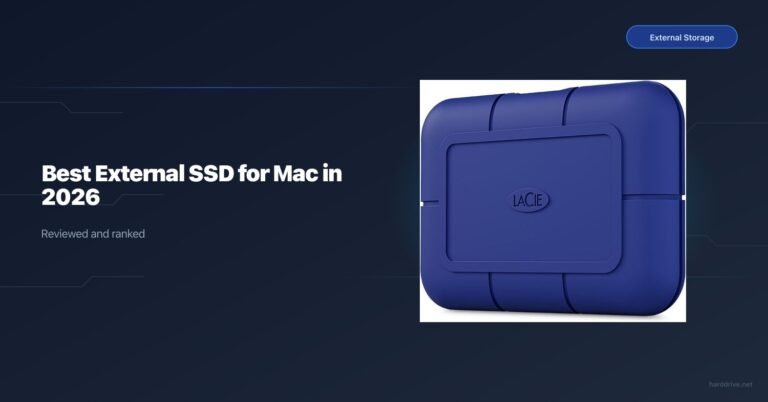
- Best External SSD for Mac — Mac-optimised picks including LaCie
- Best SSD for Video Editing — drives suited to demanding creative workflows
- Best External Hard Drive — if capacity matters more than speed